
Sleepless in Silvertown

A highly innovative project leaned heavily on trust and professional vulnerability to deliver East London’s Silvertown Tunnel on time and to budget. Dave Waller uncovers the clarity of vision and collaboration that were the secrets to its success
It was an afternoon in October 2024, and beneath the River Thames it seemed the unimaginable had happened. Monitors in the control room at Transport for London’s (TfL’s) new Silvertown Tunnel showed that a car had apparently collided with a bus, and the tunnel was rapidly filling with thick smoke. As passengers began to stumble from the vehicles, emergency teams rushed to the scene.
Thankfully, this was merely a live exercise. The obfuscating plumes came from a smoke machine; the accident victims were paid actors. But the 70 members of the fire and ambulance services on hand were real.
Also very real was the pressure on Ana Mendez Civieta, Operations Manager for the Silvertown Tunnel. She was staging the simulation while construction of the 1.4km tunnel was still incomplete.
“The first challenge was convincing the construction team that we needed to do the exercise in October,” says Mendez Civieta. “They said it was too early. But the tunnel was due to open in April, and we wouldn’t have had time to engage that many different stakeholders. That live exercise was one of my proudest moments. It was crazy, but it worked so well.”
Mendez Civieta joined the Silvertown Tunnel project in 2017. She works for Riverlinx, the consortium comprising Ferrovial, Aberdeen Investments, Invesis and SK ecoplant that won the TfL contract to design, construct, finance and maintain Silvertown in 2019. It raised the vast majority of the funding to build the new crossing, one of London’s most complex infrastructure projects, using private finance.
“The public-private partnership [PPP] contract was very important, because it told us the goal we needed to achieve,” says Mendez Civieta. “How you achieve it is your own business, but it’s there for everyone to aim towards.”
Jill takes charge
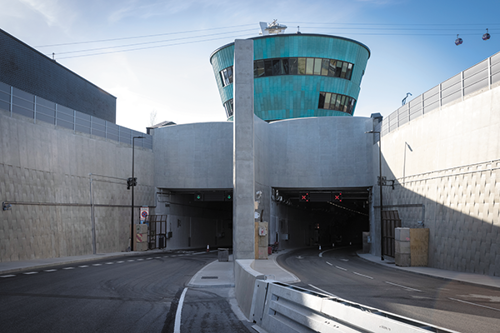
Silvertown, the twin-bore tunnel built to connect the eponymous area in Newham with the Greenwich Peninsula, is the first new road traffic tunnel to cross the Thames in London since the Blackwall Tunnel’s second bore, which opened in 1967. It was conceived to reduce congestion, improve resilience and enable an increase in the cross-river bus network in that part of London – taking the load off Blackwall, while supporting jobs and improving overall air quality.
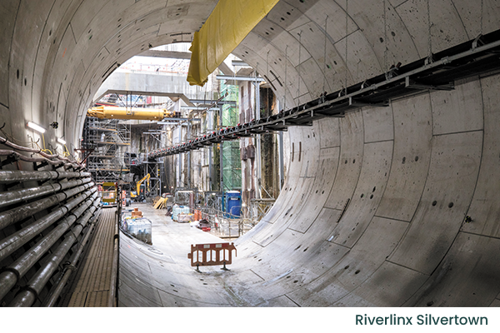
After construction work began on Silvertown in 2020, engineers were able to call on the services of Jill, an 82m-long mechanical mole with a massive rotating cutter head. It weighed 2,300 tonnes and spanned 11.9m across.
Having sent Jill from Newham to Greenwich to complete the first bore, the Riverlinx CJV team used an innovative method for the second: instead of dismantling the giant machine and transporting the pieces back to Newham to be rebuilt, they dug a giant chamber beneath Greenwich and ‘floated’ it around on nitrogen-filled cushions. This enabled them to complete the work in less than a year. By that time, in July 2023, Jill had lined the tunnel with 1,120 ring segments weighing more than 70 tonnes.
Intense times
The project team also had to build a new highway. The site was on old industrial land, which meant engaging a huge number of stakeholders to get buy-in or navigate land purchases. Add in a large number of unexploded WWII-era bombs, plus the COVID-19 pandemic, the war in Ukraine and soaring inflation, and they could have been digging a deep hole for themselves.
Yet despite the scale of the challenge, the project came in bang on time and to budget. Nick Boot-Handford, Senior Programme Manager at TfL and the organisation’s representative on the Silvertown PPP, credits the strength of the TfL-Riverlinx collaboration.
“We didn’t have a textbook for how a contracting authority should manage a PPP to do this,” he says. “Before awarding the contract, we had to state clearly how we’d operate it, which drove us to a far better understanding than we’d ordinarily have. But the formal structures we put in place were only as good as the informal relationships we built to make it work. It became less about strict contractual roles and more about how we worked together to achieve the best outcome.”
For Boot-Handford, the project team also proved adept at risk management: “At the outset, we understood what the key risks to the project were, and we officially gave each to the best party to manage it. No one was holding massive risks they weren’t able to mitigate. We also built a high level of trust, where we could be professionally vulnerable, ask for other perspectives and work out solutions together. We could navigate tricky points without it all falling apart.”
Living and breathing it
The Silvertown Tunnel was due to open on 7 April 2025. Mendez Civieta lives near the Silvertown site. She recalls returning home late after one long day on the project and opening her postbox to find a leaflet that read: “Silvertown Tunnel: Opens 7 April”. “I thought: ‘Please leave me alone,’” she laughs.
 Boot-Handford recalls how he used to see dot matrix road signs on his running route, flashing up that due date to remind motorists to pre-register for the new tunnel charges.
“There were plenty of sleepless nights for me in the latter stages,” he recalls. “It was incredibly intense. We had 40 key stakeholders who all needed to sign off that the tunnel was ready to open, and they saw my team as the way to drive it all. We ended up having to collate 2,600 pieces of assurance. Was it going to open on 7 April, or would it be a week later? In my world, the latter would have been an absolute catastrophe.”
As the months were crossed off the calendar through late 2024, the team began meeting every morning to establish the key areas of focus and what needed to happen. Once again, success came down to having planned properly from the start.
“The magnitude of it was the overwhelming thing,” says Larry Mackey, the Silvertown Tunnel’s Quality Director, who worked closely with Boot-Handford and Mendez Civieta. “The list of things on the schedule for completion was absolutely massive. But once we had that schedule, we knew what we had to do and when we had to do it by. Those were really the only two variables. We got them under control and the pile kept reducing. We met at nine every morning, and by half 10, more items had been taken off that list.”
When 7 April finally rolled around, all that stress vanished. The Silvertown Tunnel opened without fanfare at about one o’clock in the morning. Boot-Handford jumped in his car and drove through it, beaming with pride. The next morning, Mackey drove up the A102 to work early, just to take it all in. “I was so absolutely in awe of the tunnel I nearly crashed,” he says.
The response to Silvertown hasn’t always been so positive. Despite public engagement throughout the process, the tunnel has been criticised, whether for its lack of provision for cyclists (it has been called “a 20th century solution to a 21st century problem”), the charges facing drivers or the total cost, which is reported to be around £2bn over 25 years, taking in construction, operation, maintenance and financing. But the benefits speak for themselves: early monitoring shows reduced congestion around Blackwall and a 70% decrease in journey times for some in the area; an increase in the average speed from 9mph to the maximum of 30mph; and after six months an estimated 292% increase in cross-river bus trips, with new zero-emission double-decker buses running through the tunnel. The list goes on.
Reckoning with public criticism, Boot-Handford says: “My advice to anyone delivering projects that are not universally supported is threefold. First, personally believe in the project and the benefits it is intended to deliver. Second, listen carefully and respectfully, recognising that opposition often comes from valid concerns that can either be addressed or, at the very least, used to strengthen the delivery. Even where this is not possible, people still deserve to be heard. Finally, remember that it is not personal. No matter how all-consuming a project like this can feel at times, the sense of achievement when it is completed is worth it.”
Sticking with it
And while the PPP has come in for its share of criticism over the years, too, the Silvertown team insist it’s been key to the project’s success. Instead of contractors simply driving away from the project once it’s done, Riverlinx is contracted to operate the tunnel for the next 25 years. That continuity means all members of the consortium have been able to keep the eventual operation of the tunnel, its long-term safety and efficiency goals front of mind from the very start.
“The tunnel has some systems that have never been used in the UK before,” says Mackey, “like a fixed fire-fighting system that works in combination with the ventilation. There was no example that you could just copy and paste, so that was developed along with the designers. It was about making sure they understood the final outcome, because they were the ones finding the solutions.”
On 7 April, the first day of 25 years of Riverlinx operations, Mendez Civieta chose to take the bus home from work. She may have seen that tunnel forming slowly over the previous five years, but as she traversed it for the first time as a passenger, she couldn’t help behaving like a tourist who’d finally found herself in a place she’d spent her life dreaming of visiting. “I did cry a little bit,” she says. “People on the bus may have thought I was crazy, but they were all staring at their screens. ‘Why aren’t you looking at the tunnel?’ I thought. ‘You’re missing it!’”
This is a Project article for paying members only. Browse more articles here.

Emma De Vita is editor of Project, the official magazine exclusive for paying members.
0 comments
Log in to post a comment, or create an account if you don't have one already.